
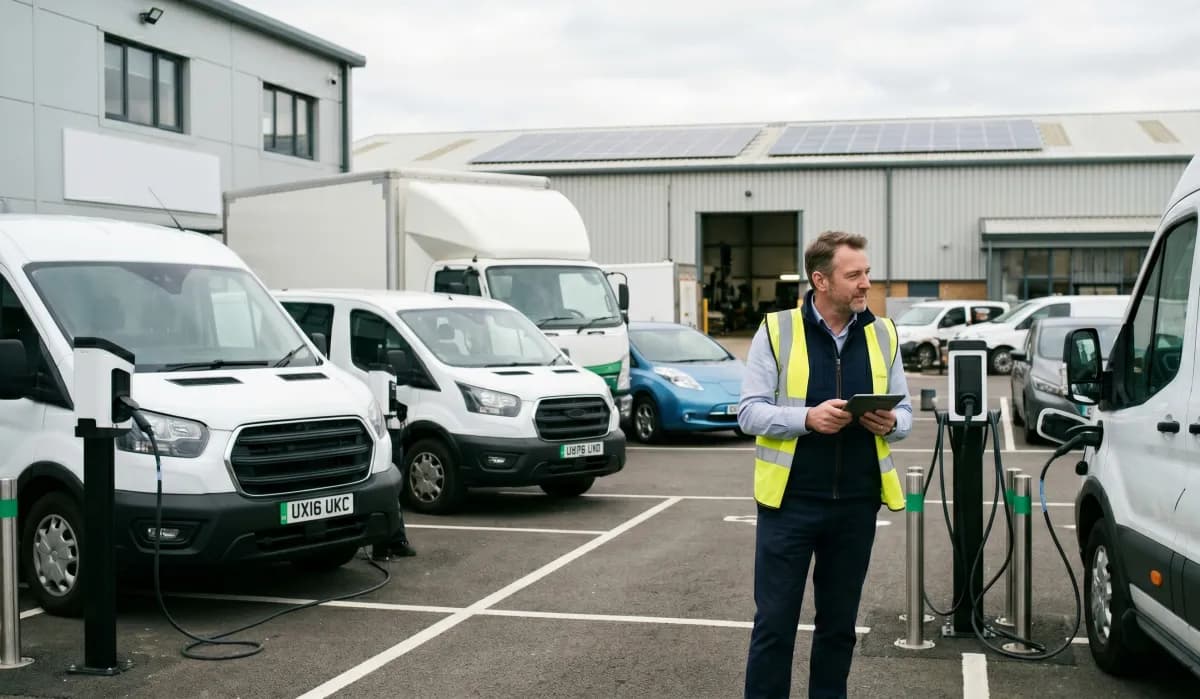
EV Fleet Transition: What UK Fleet Managers Need to Know in 2026
EV Fleet Transition: What UK Fleet Managers Need to Know in 2026
The electric vehicle revolution is no longer on the horizon — it is here, accelerating, and creating a complex set of decisions for UK fleet managers that few have faced before. Choosing when, how, and how quickly to electrify a fleet requires a combination of vehicle specification knowledge, financial modelling, infrastructure planning, and supplier relationship management that can be genuinely overwhelming.
This guide distils the most critical considerations for fleet managers in 2026 and explores how the right data and decision-support tools can make the transition significantly more manageable.
The Business Case for Fleet Electrification in 2026
The financial case for EV fleet adoption has strengthened considerably over the past two years. Benefit-in-kind (BIK) tax rates for zero-emission company cars remain dramatically lower than for ICE vehicles — 3% in 2026/27 compared to rates as high as 37% for high-emission vehicles. For employees driving company cars, this difference can represent thousands of pounds in annual personal tax savings, making EVs a powerful recruitment and retention tool as well as a cost reduction measure.
For van fleets, the calculation is more nuanced but increasingly favourable. The cost per mile for electric vans on high-mileage duty cycles is significantly lower than diesel, and maintenance costs are substantially reduced given fewer moving parts and no oil changes. Total cost of ownership comparisons favour EVs across an increasing range of applications.
Key Challenges Fleet Managers Are Navigating
Range Anxiety and Duty Cycle Suitability
The most common barrier to EV fleet adoption is uncertainty about whether EVs can handle the specific duty cycles of the fleet in question. A company car driver doing 200 miles per day on motorways has very different requirements to a field service engineer making multiple short-stop visits. The critical first step in any EV transition is a rigorous duty cycle analysis — and this requires accurate telematics data, not assumptions.
Charging Infrastructure
Charging infrastructure remains the most complex practical challenge in fleet electrification. Key questions include: Does the depot have sufficient electrical capacity for overnight charging? Are drivers able to charge at home? What is the reimbursement policy for home charging? How will the business manage charging costs? Which public charging networks are reliable enough for operational use?
Fleet managers who have navigated this successfully almost universally report that infrastructure planning — ideally with specialist support — needed to begin 12 to 18 months before the first EV arrived on fleet.
Vehicle Specification and Availability
The EV market is evolving extraordinarily rapidly. A vehicle specification that appeared optimal 18 months ago may already be superseded. Fleet managers need access to accurate, up-to-date vehicle specification data that covers the full range of available models, their real-world performance, charging capability, and total cost of ownership across different scenarios.
Our vehicle specification data service provides exactly this — comprehensive, current, independently verified specification data that enables fleet managers to make truly informed choices.
The Whole Life Cost Question
Purchase price comparisons between EVs and ICE vehicles are almost meaningless in isolation. The relevant metric is whole life cost: the total cost of acquisition, running, maintenance, insurance, and disposal over the planned fleet cycle. Our Whole Life Cost Toolkit enables fleet managers to model these costs accurately across multiple vehicle options, duty cycles, and financing structures, producing genuinely comparable data that supports confident procurement decisions.
Fleet Data as a Foundation for Transition Planning
Effective EV transition planning is impossible without good data. Fleet managers need comprehensive data on their current vehicle portfolio: age, mileage, contract end dates, fuel consumption, CO2 emissions, and total running costs. This data, combined with telematics insights on actual journey patterns, forms the foundation of a credible transition roadmap.
Our fleet data and profiled fleet data services help fleet managers build and maintain the data foundation they need for strategic decision-making. Whether you are reviewing your own fleet or prospecting for fleet clients who are approaching transition decisions, accurate data is the starting point.
A Phased Approach to EV Transition
Few organisations can or should transition their entire fleet overnight. A phased approach — starting with the vehicles and drivers best suited to electrification and expanding from there — reduces risk, builds organisational learning, and allows charging infrastructure to be developed in step with the growing EV fleet.
The most successful fleet transitions we have seen share common features: a clear roadmap with phased milestones, strong internal communication about the rationale and benefits, robust charging infrastructure planning, and supplier partners who provide genuine advisory support rather than simply selling vehicles.
How XL Marketing Supports Fleet Sales Professionals
If you are in automotive fleet sales and want to reach the fleet managers who are actively planning their EV transitions, our data and lead generation services can connect you with the right decision-makers at exactly the right moment. Get in touch with our team in Chorley on 01772 585111 to discuss how we can support your fleet sales programme.